Defending the Industrial Edge From Wandering AI Agents
The Rise of the Autonomous Agent in Industrial Environments
The promise of agentic AI is transforming the landscape of industrial operations. We are moving beyond simple chatbots into an era of autonomous agents—software entities capable of making decisions, executing workflows, and interacting with critical infrastructure through the Model Context Protocol (MCP) and RESTful APIs. However, this new frontier brings a significant security paradox: how do you grant an autonomous agent enough access to be useful without creating a "wandering agent" that can pivot across your entire network?
In traditional environments, once a service is authenticated, it often enjoys broad lateral visibility. For an AI agent tasked with optimizing a power grid or managing a manufacturing line, this level of access is a catastrophic risk. If an agent enters a "runaway loop" or is compromised by an adversarial prompt, it can rapidly move from its intended data source to sensitive internal systems. The perimeter-first playbook—relying on static ACLs and legacy VPNs—has no answer for an entity that operates at the speed of silicon and lacks a human's contextual judgment.
To secure this new era of agentic automation, the industry must shift toward a zero-trust runtime that provides explicit, identity-authenticated service bindings. This is where the synergy between VeilNet Conflux and VeilNet Aether becomes the essential architectural foundation for the modern industrial edge.
Conflux and the Meta Air Gap
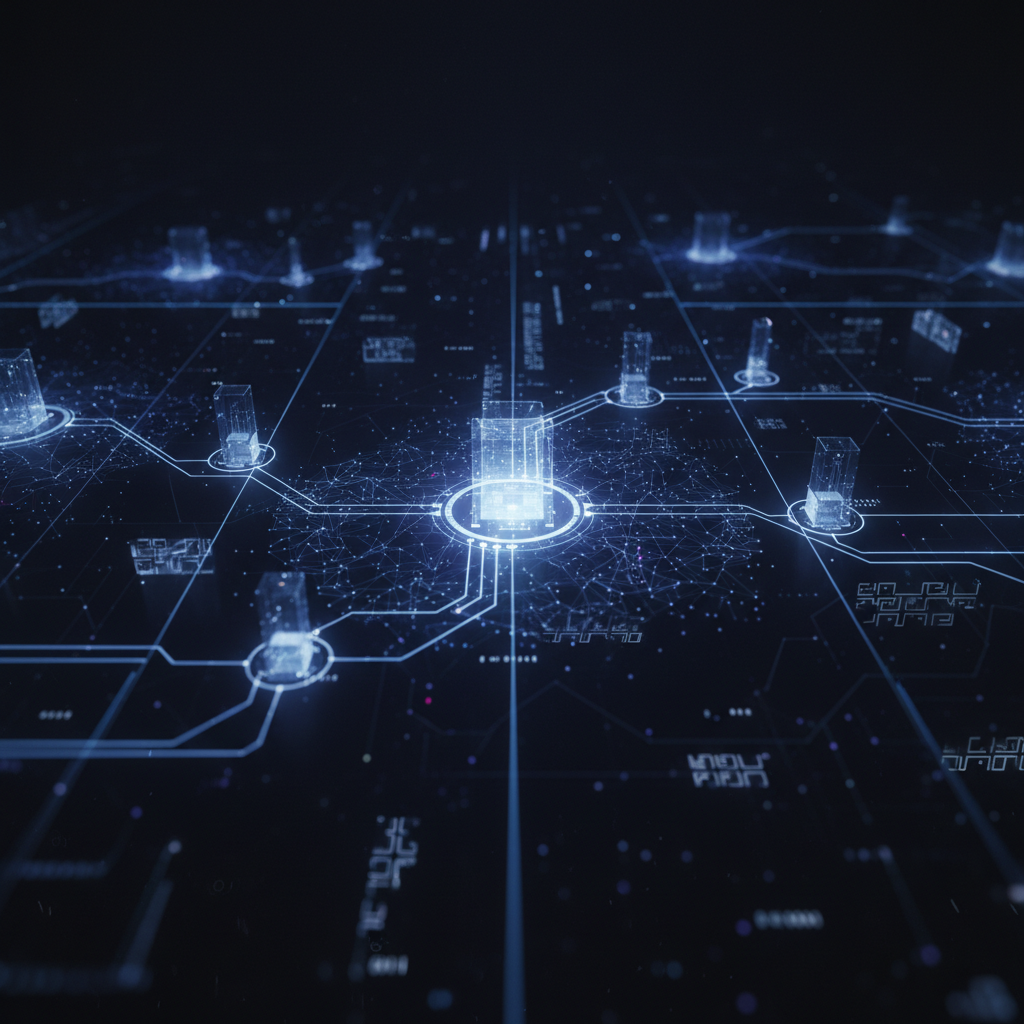
The first line of defense against wandering agents is ensuring the network itself is invisible. Traditional networking exposes IP addresses and open ports to anyone on the local segment. In contrast, VeilNet Conflux acts as the secure post-quantum network connector, establishing an identity-authenticated mesh that effectively creates a "meta air gap."
Conflux does not rely on the presence of a traditional network perimeter. Instead, it utilizes quantum-resistant packet routing to ensure that every connection is cryptographically verified before a single bit of data is exchanged. For an AI agent, this means the network simply does not exist until the agent’s identity is authenticated through the Conflux fabric. There are no "internal" systems to discover or ping; the agent only sees the specific resources it has been explicitly authorized to access.
This compartmentalization is vital. By leveraging Conflux, infrastructure architects can ensure that even if an agentic AI process is hijacked, its blast radius is restricted to the specific micro-segment defined by its identity. The "meta air gap" prevents the agent from seeing or interacting with other nodes on the mesh, stopping lateral movement in its tracks. Because the routing is post-quantum resistant, these protections are future-proofed against the looming threat of Shor’s algorithm, ensuring that long-lived industrial assets remain secure for decades.
Aether and the Industrial Data Plane
If Conflux provides the secure tunnel, VeilNet Aether provides the intelligent gateway. Aether is the real-time engine that sits above the Conflux network layer, serving as the industrial data plane. It is specifically designed to handle the complex integrations required for modern AI and OT convergence, including OPC UA, RESTful APIs, and the Model Context Protocol (MCP).
Aether’s support for MCP is particularly relevant in the age of agentic AI. MCP is the emerging standard that allows AI models to safely access external data and tools. By acting as the MCP host, Aether provides the "secure service bindings" necessary to prevent runaway agentic loops. When an agent requests data from a PLC via OPC UA or an external database via a RESTful API, Aether evaluates the request in real-time.
Aether doesn't just pass traffic; it understands the industrial protocols it is routing. It provides a granular control point where OT engineers can define exactly what an agent is allowed to do. Can the agent read the temperature sensors? Yes. Can it adjust the cooling valve? Only under specific, pre-defined conditions. This level of protocol-aware security ensures that the agent remains a tool for optimization rather than a liability for safety.
Preventing the Runaway Agentic Loop
The danger of autonomous AI isn't just malicious intent; it is also unintended behavior. A "runaway loop" occurs when an agent repeatedly executes a command or accesses a resource in an infinite cycle, potentially DOSing (Denying of Service) critical industrial equipment.
VeilNet Aether addresses this through its real-time engine capabilities. By monitoring the flow of data through the industrial plane, Aether can enforce resource limits and rate-shaping on a per-agent basis. If an agent starts exhibiting anomalous behavior—such as requesting data at a frequency that threatens the stability of an OPC UA server—Aether can automatically throttle or sever the connection.
This creates a "sandboxed" runtime environment. The agent is free to operate within its defined parameters, but the moment it attempts to "wander" into unauthorized data sets or exceed its resource limits, the system intervenes. This isn't just about identity; it’s about behavior and context. Because Aether is integrated directly with the Conflux mesh, these security decisions are enforced at the packet level, providing a level of performance and security that software-only overlays cannot match.
Eliminating Credential Risks with Identity Authentication
One of the most common breach vectors in industrial environments is the theft of static credentials or the hijacking of session tokens. In an agentic AI workflow, these tokens are often stored in memory or environment variables, making them prime targets for attackers.
VeilNet eliminates this risk by moving away from static secrets. Conflux uses identity-authenticated networking where the identity is baked into the network fabric itself. There are no passwords for an agent to leak because the connection is dependent on a hardware-rooted or cryptographically-secure identity that Conflux verifies at every step.
Furthermore, Aether extends this zero-trust model to the data layer. Every RESTful API call or MCP tool execution is tied to the authenticated identity provided by Conflux. This ensures that even if an attacker manages to inject a prompt into the AI agent, the agent cannot be used as a proxy to execute unauthorized commands. The "identity" is the access control list, and it is enforced globally across the mesh.
The Post Quantum Reality Check
As organizations look toward 2027 and beyond, the move to zero trust is no longer optional—it is a mandate. However, many current implementations are "stuck in the past," relying on encryption standards that will not survive the arrival of cryptographically relevant quantum computers (CRQCs).
For CISOs managing critical infrastructure, the investment in agentic AI must be protected by a post-quantum foundation. VeilNet’s Conflux provides this today. By implementing post-quantum zero trust now, organizations can avoid a costly "rip and replace" cycle in the near future. Conflux ensures that the encrypted tunnels protecting your AI agents and industrial data remain secure even against future quantum adversaries.
A Unified Architecture for Secure Industrial Intelligence
The convergence of Conflux and Aether represents a fundamental shift in how we secure industrial intelligence. We are moving away from the "paperwork" of zero trust—policies that are written but rarely enforced—to a technical reality where security is an inescapable part of the network and data plane.
By using Conflux for identity-authenticated mesh networking and Aether for protocol-aware data integration, enterprises can finally realize the benefits of agentic AI without the associated risks of wandering agents or runaway loops. This architecture provides the "meta air gap" needed to isolate critical systems, the "secure service bindings" needed to limit AI autonomy, and the post-quantum resilience needed to protect the future of industry.
In the era of autonomous machines and intelligent agents, the network can no longer be a passive pipe. It must be an active, identity-aware participant in the security of the enterprise. VeilNet Conflux and Aether are the tools that make that vision a reality, providing a definitive solution for the most pressing challenges of the modern industrial edge.
Defending Industrial Infrastructure Beyond the False Security of Traditional Air Gaps
Learn how VeilNet secures legacy OT environments using post-quantum zero trust and industrial data engines to eliminate lateral movement and network exposure.
Demolishing the LAN Fallacy with Post Quantum Edge Trust
Eliminate physical perimeter security risks. Secure operational technology and edge networks with VeilNet Conflux and Aether post-quantum zero-trust mesh.