Defending Industrial Infrastructure Beyond the False Security of Traditional Air Gaps
The Fragility of Modern Industrial Connectivity
For decades, the security of industrial control systems (ICS) and operational technology (OT) rested on a single, physical premise: the air gap. The logic was simple. If a programmable logic controller (PLC) or a SCADA server was not connected to the public internet, it could not be compromised by external actors. However, the requirements of the modern enterprise—real-time data analytics, remote monitoring, and predictive maintenance—have effectively dissolved these physical boundaries.
As OT environments become increasingly interconnected, they are being forced into a digital landscape they were never designed to navigate. Legacy systems, often running on decades-old hardware with unpatchable vulnerabilities, are now exposed to a sophisticated threat landscape. Nation-state actors and ransomware groups are no longer just targeting IT databases; they are pre-positioning themselves within industrial networks, seeking the lateral movement paths that lead from a compromised employee laptop to the critical cooling systems of a data center or the turbine controls of a power plant.
The traditional response has been to bolt on IT-centric security tools—VPNs, firewalls, and static network segmentation. But in a world where stolen credentials represent the primary vector for initial access, and where encrypted traffic can be intercepted now for decryption later by quantum computers, these defenses are no longer sufficient. To secure the infrastructure of tomorrow, we must move beyond the illusion of the air gap and embrace a post-quantum, zero-trust architecture that treats every packet and every identity as potentially hostile.
The Meta Air Gap and the Conflux Mesh
The fundamental flaw in traditional network security is the existence of the "perimeter." Once an attacker bypasses the firewall or authenticates via a compromised VPN credential, they are "inside" the network. From there, lateral movement is often a matter of simple network discovery. VeilNet’s Conflux changes this paradigm by replacing the vulnerable perimeter with a decentralized, identity-authenticated mesh.
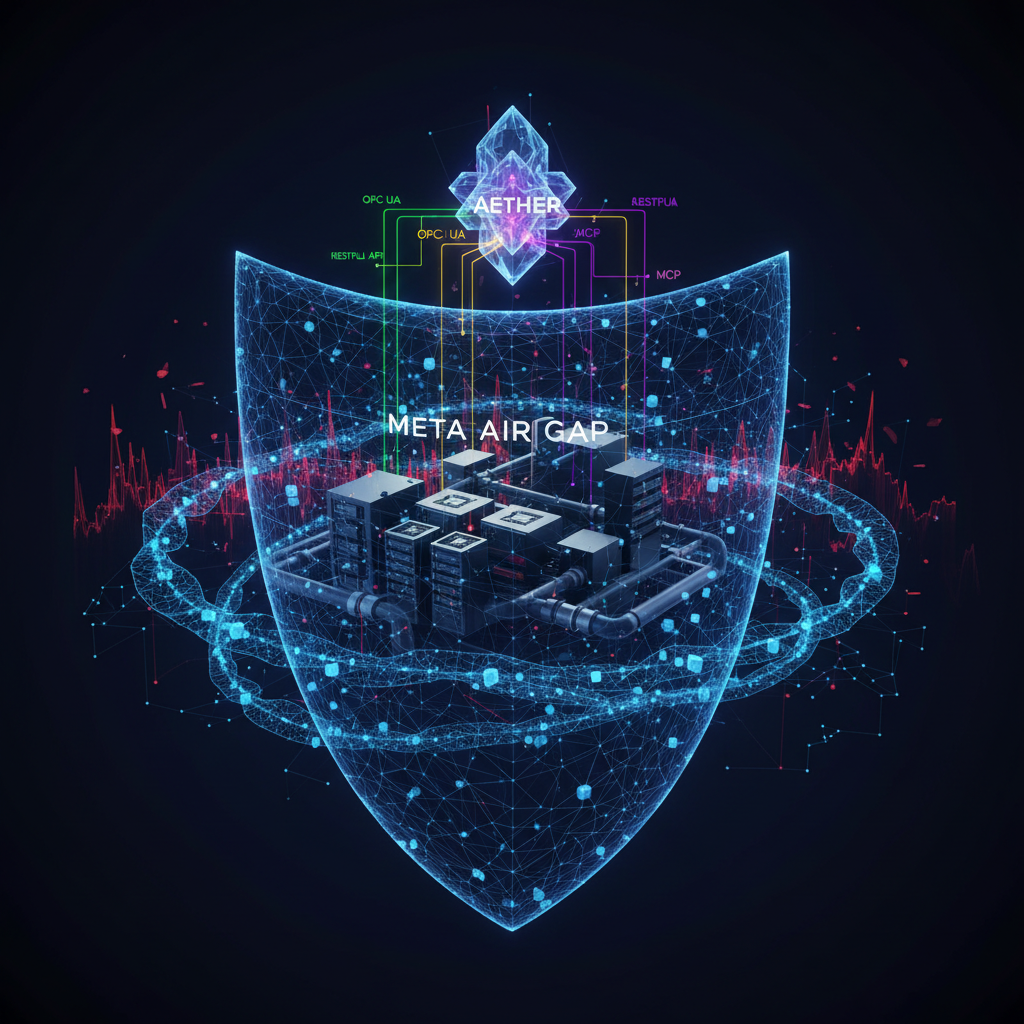
Conflux functions as a secure network connector that establishes what we call the "Meta Air Gap." Unlike a traditional air gap, which relies on physical isolation, the Meta Air Gap uses logical isolation powered by post-quantum cryptography (PQC). In a Conflux-enabled environment, assets are completely hidden from the public internet. There are no open ports to scan, no public IP addresses to target, and no centralized brokers to compromise.
The architecture is built on a peer-to-peer (P2P) mesh where every connection is explicitly authorized and continuously verified. Before a single packet is routed, the identities of both the source and the destination are cryptographically validated. This "authenticate-first, connect-later" approach ensures that even if an attacker gains access to a local segment of the network, they cannot "see" other assets on the Conflux mesh. To the rest of the world—and to the attacker—the infrastructure simply does not exist.
Furthermore, Conflux is engineered for the future of cryptography. We are currently in the "harvest now, decrypt later" era, where adversaries are capturing encrypted traffic today in anticipation of the day a commercially viable quantum computer can break RSA and ECC encryption. Conflux mitigates this risk by utilizing quantum-resistant packet routing. By securing data in transit with PQC, VeilNet ensures that the industrial secrets of today remain secure well into the quantum age.
Bridging Legacy Constraints with Aether
The challenge for OT engineers is not just networking; it is the data itself. Industrial environments are often a "brownfield" of competing protocols and aging hardware. A sensor might speak OPC UA, while a legacy management system expects a RESTful API, and a modern AI-driven maintenance tool requires integration via the Model Context Protocol (MCP).
Securing these data flows while maintaining interoperability is the role of Aether, VeilNet’s real-time industrial engine. Aether sits above the Conflux network layer, providing the specialized data plane required for modern industrial operations. It acts as the intelligent translator and gatekeeper for critical OT data.
One of the most significant risks in OT security is the "improperly secured pathway"—a connection made for convenience that inadvertently creates a bridge between a high-security OT zone and a lower-security IT zone. Aether eliminates this risk by enforcing zero-trust principles at the protocol level. When Aether handles an OPC UA stream, it isn't just moving data; it is ensuring that the data is only accessible to authenticated entities identified within the Conflux mesh.
For organizations looking to leverage artificial intelligence to optimize their industrial processes, Aether provides a secure path through its MCP integrations. This allows AI agents to interact with industrial data in a controlled, audited environment. By providing a secure, identity-aware interface for industrial protocols, Aether allows organizations to modernize their operations without exposing their core logic to the risks of the open web.
Eliminating the Attack Surface
In a traditional zero-trust implementation, security teams often struggle with "static" policies—rules that are set once and rarely re-evaluated. This creates a window of opportunity for attackers between the time a device is compromised and the time its session expires. VeilNet’s architecture is fundamentally dynamic.
Because Conflux is brokerless and peer-to-peer, there is no single point of failure. If one node in the mesh is suspected of compromise, its identity-based access can be revoked instantly across the entire network. This level of granular control is essential for managing the growing attack surfaces of interconnected OT environments.
Moreover, the VeilNet platform addresses the "shadow OT" problem. As departments add new sensors, gateways, and smart devices, the network grows more complex and harder to defend. With VeilNet, any new device must be explicitly provisioned into the Conflux mesh before it can communicate. This brings the entire industrial footprint under a single, unified security umbrella, providing CISOs with the visibility they need to ensure compliance and resilience.
The Path to Industrial Resilience
The transition to zero trust is often described as a journey rather than a destination. For OT environments, this journey is complicated by legacy constraints and the absolute requirement for uptime. You cannot simply "turn off" a power plant to install a new security agent.
VeilNet is designed to be deployed alongside existing infrastructure, providing an immediate layer of protection without requiring a "rip and replace" of legacy systems. By wrapping legacy assets in a Conflux-secured Meta Air Gap and using Aether to manage data delivery, organizations can achieve a level of security that was previously impossible.
The guidance from global cybersecurity agencies is clear: the era of trusting the internal network is over. We must assume that breaches will occur and that attackers will attempt to exploit the gaps between IT and OT. VeilNet provides the tools to close those gaps. By combining identity-authenticated mesh networking with post-quantum resistance and industrial-grade protocol management, we enable organizations to build a truly resilient infrastructure.
In the face of nation-state threats and the looming quantum challenge, the question for infrastructure architects is no longer if they should implement zero trust, but how quickly they can move away from the vulnerable architectures of the past. VeilNet is the definitive answer for those who refuse to compromise on the security of the systems the world relies on every day.
Defending Critical Infrastructure with Post Quantum Zero Trust Architecture
Protect legacy OT and industrial networks from nation-state threats using VeilNet's post-quantum zero-trust meta air gap and secure data plane architecture.
Defending the Industrial Edge From Wandering AI Agents
Discover how VeilNet Conflux and Aether provide a secure post-quantum foundation to prevent autonomous AI agents from compromising industrial infrastructure.