
Securing Operational Technology for the Post Quantum Era
The Growing Pressure on Operational Technology
Operational Technology (OT) asset owners are facing a mounting challenge that traditional cybersecurity frameworks are ill-equipped to handle. As regulatory bodies begin to mandate attestations for post-quantum cryptographic (PQC) readiness, a significant gap has emerged between compliance requirements and the practical reality of industrial environments. Most OT infrastructures rely on legacy systems that were never designed with modern encryption in mind, let alone the specialized requirements of quantum-resistant algorithms.
This "readiness gap" is not merely a bureaucratic hurdle. It represents a fundamental vulnerability in how critical infrastructure communicates. While the arrival of a cryptographically relevant quantum computer (CRQC) may still be on the horizon, the threat of "Harvest Now, Decrypt Later" (HNDL) is immediate. In these scenarios, adversaries capture encrypted traffic today with the intent of decrypting it once quantum processing power becomes available. For industrial systems with life cycles spanning decades, data captured today must remain secure for the next twenty to thirty years.
The difficulty for OT engineers lies in the fact that legacy hardware often lacks the computational overhead to run NIST-standardized post-quantum algorithms. Patching a twenty-year-old Programmable Logic Controller (PLC) to support Kyber or Dilithium is physically and logically impossible. Consequently, organizations are searching for a way to wrap these vulnerable industrial endpoints in a protective, quantum-resistant fabric without disrupting existing operations or requiring a total hardware overhaul.
Bridging the Gap with Conflux and the Meta Air Gap
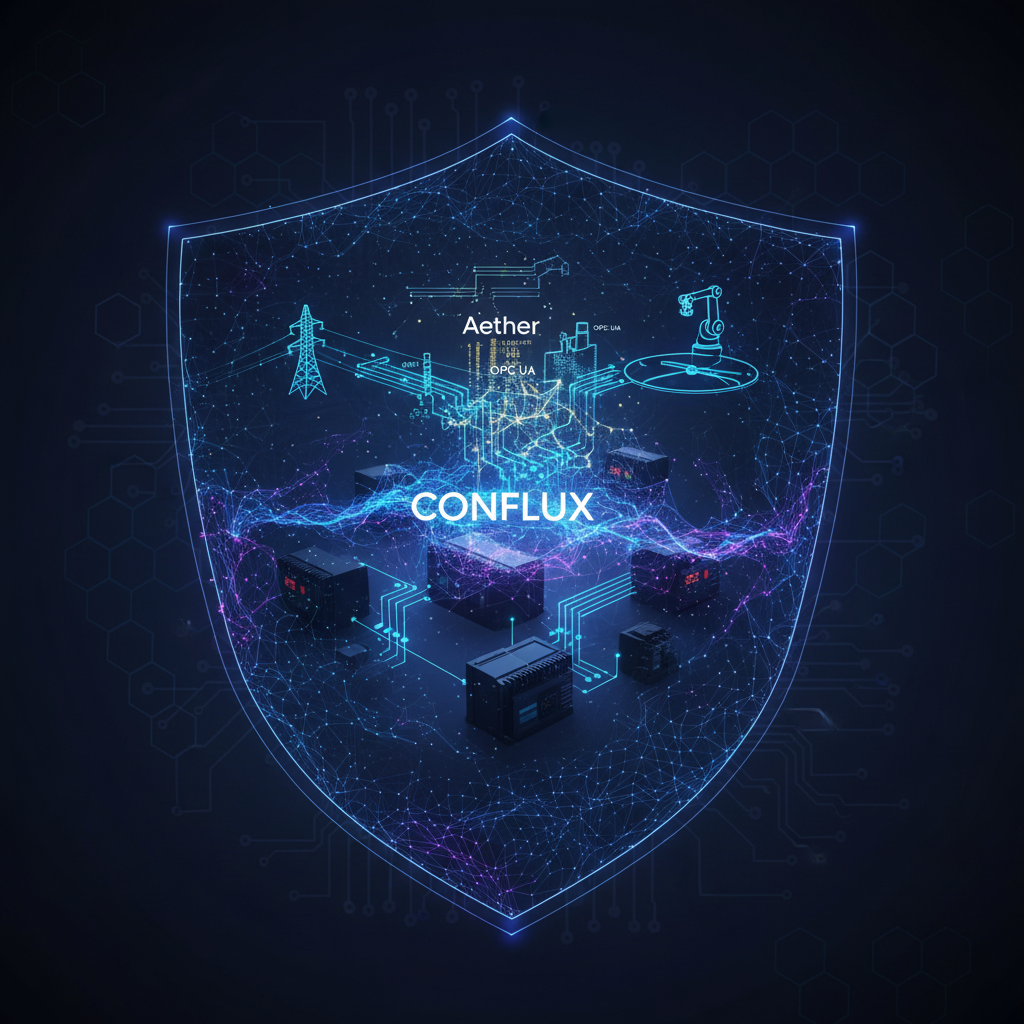
The solution to the PQC readiness problem does not lie at the endpoint level, but at the network layer. This is where VeilNet’s Conflux provides a critical transition path. Conflux is designed as a secure post-quantum network connector that establishes an identity-authenticated mesh network. By decoupling security from the physical hardware of the OT asset, Conflux allows even the oldest industrial components to benefit from state-of-the-art protection.
At the heart of this architecture is the "Meta Air Gap." Traditional air-gapped networks—networks physically disconnected from the outside world—are increasingly rare and difficult to maintain in an era of digital transformation and remote monitoring. Conflux recreates the security benefits of an air gap through software-defined, quantum-resistant packet routing. It renders the internal network invisible to the public internet, ensuring that only authenticated identities can even attempt a connection.
Because Conflux utilizes post-quantum cryptographic standards for its identity verification and packet routing, it provides an immediate answer to regulatory demands for PQC readiness. The network itself becomes the guardian. When a packet enters the Conflux fabric, it is encapsulated in a quantum-resistant tunnel, protecting it against both contemporary and future cryptographic threats. This allows OT asset owners to attest to readiness today, while the underlying industrial hardware remains untouched and operational.
The Role of Aether in Industrial Data Integrity
While Conflux handles the secure transit of data across the mesh, the industrial data plane requires its own specialized management. This is the role of Aether, VeilNet’s real-time engine. In many OT environments, the primary challenge is not just security, but the translation and integration of industrial protocols like OPC UA.
Legacy OPC UA implementations are notoriously difficult to secure across distributed networks. They often rely on complex certificate management and static firewall rules that are brittle and difficult to scale. Aether provides the industrial data plane above the Conflux network layer, specifically handling OPC UA, RESTful API, and MCP (Model Context Protocol) integrations.
By deploying Aether in conjunction with Conflux, organizations can ingest raw industrial data at the edge and transport it across the post-quantum mesh with total confidence. Aether acts as the intelligent bridge, ensuring that the real-time requirements of industrial systems are met while maintaining the rigorous security posture defined by the zero-trust architecture. This integration is essential for modern OT use cases, such as sending telemetry data to a centralized Monitoring and Control Center or feeding real-time diagnostics into an AI-driven predictive maintenance model.
Eliminating the Perimeter with Identity-Authenticated Mesh Networking
The traditional "castle and moat" approach to OT security is failing. Static Access Control Lists (ACLs) and VPNs are no longer sufficient to protect against sophisticated actors who can exploit a single compromised credential to move laterally through a flat network. The move toward zero-trust networking requires a shift from location-based trust to identity-based trust.
Conflux facilitates this shift by ensuring that every node in the mesh network has a cryptographically verified identity. This identity is authenticated before a single packet is routed. In a Conflux-powered environment, the network does not "see" IP addresses in the traditional sense; it sees authenticated identities. This prevents lateral movement by design. If a specific PLC is authorized to speak only to a specific HMI (Human-Machine Interface), the Conflux mesh enforces that path exclusively. Any attempt to deviate from this pre-defined identity mapping is ignored by the routing layer.
This granularity is vital for OT engineers who must maintain high availability. Unlike traditional firewalls that can fail open or be misconfigured to block legitimate traffic, the identity-authenticated mesh provides a deterministic path for industrial data. It simplifies the network architecture by removing the need for complex VLAN segmentation and secondary security appliances that often introduce latency and points of failure.
Future-Proofing Critical Infrastructure
The transition to post-quantum cryptography is often compared to the Y2K bug, but with a critical difference: the "deadline" for quantum readiness is unknown, and the consequences of being late are permanent. For organizations managing power grids, water treatment plants, or manufacturing floors, the cost of a cryptographic breach is catastrophic.
VeilNet’s approach recognizes that OT environments cannot be rebuilt overnight. The combination of Conflux and Aether offers a non-disruptive path to modern security. By implementing a post-quantum network connector that handles the heavy lifting of PQC, organizations can protect their existing investments in industrial hardware.
Furthermore, the inclusion of MCP and RESTful API support in Aether ensures that the network is ready for the next wave of industrial innovation. As agentic AI and autonomous systems become more prevalent in OT, the need for a secure, high-bandwidth, and low-latency data plane will only grow. VeilNet provides this foundation today, ensuring that the move toward "Industry 4.0" is not hampered by the security vulnerabilities of the past.
From Compliance to Comprehensive Resilience
Regulatory pressure is often seen as a burden, but in the context of post-quantum readiness, it serves as a necessary catalyst for change. The tools to secure OT environments against future threats exist, but they require a departure from the status quo of network engineering.
Asset owners must move beyond simple "check the box" compliance. True resilience requires an architecture that is secure by design, quantum-resistant by default, and invisible to adversaries. By leveraging Conflux for post-quantum mesh networking and Aether for industrial data integration, organizations can close the cryptographic readiness gap and ensure the long-term integrity of their most critical assets.
The era of trusting the network perimeter is over. The era of identity-authenticated, post-quantum protected industrial data has begun. VeilNet stands at the forefront of this transition, providing the tooling necessary to transform vulnerable legacy environments into resilient, future-proof infrastructures. Organizations that act now to implement these documented capabilities will not only meet the requirements of today’s regulators but will also be the ones that survive the cryptographic shifts of tomorrow.
Securing Non-Human Workloads with Post Quantum Zero Trust
Discover how VeilNet Conflux and Aether secure non-human workloads, agentic AI, and OT environments against lateral movement and future quantum threats.
Securing Operational Technology Beyond Vulnerable Industrial VPNs
Explore why traditional factory VPNs expose OT networks to ransomware and how identity-authenticated mesh networking secures critical industrial assets.