Hardening Industrial Infrastructure with the Meta Air Gap
The Growing Vulnerability of Industrial Infrastructure
The landscape of industrial cybersecurity has reached a critical inflection point. As operational technology (OT) systems become increasingly interconnected, digitally monitored, and remotely operated, the attack surfaces available to malicious actors are multiplying. The traditional reliance on "air-gapping"—the physical isolation of control systems from the public internet—is rapidly dissolving under the pressure of digital transformation. Today, the need for real-time data analytics, remote maintenance, and supply chain integration has forced a marriage between sensitive OT environments and the inherently volatile IT world.
This convergence has created a "Legacy Trap." Critical infrastructure is often built on hardware and protocols designed decades ago, long before the current threat landscape existed. These systems frequently lack the processing power for modern encryption or the interface for multi-factor authentication. When these legacy constraints meet growing attack surfaces, the result is a massive security gap. Adversaries are no longer just probing the perimeter; they are actively pre-positioning themselves within OT networks, moving laterally from compromised IT endpoints into the heart of industrial control systems.
To survive this era of persistent threats and nation-state targeting, infrastructure architects and CISOs must move beyond traditional defense-in-depth strategies. The goal is no longer just "more security tools" or faster detection—it is absolute containment. This requires a fundamental shift in how we think about network connectivity, identity, and the very concept of an air gap.
Redefining Security with the Meta Air Gap
The most significant challenge in securing OT environments is providing access without providing a path. Traditional VPNs and firewalls create a "door" in the network perimeter. Even if that door is locked with strong authentication, the door itself exists as a routable IP address that can be scanned, attacked, and potentially exploited. Once a single device is compromised, the "Patient Zero" effect allows the breach to escalate within minutes.
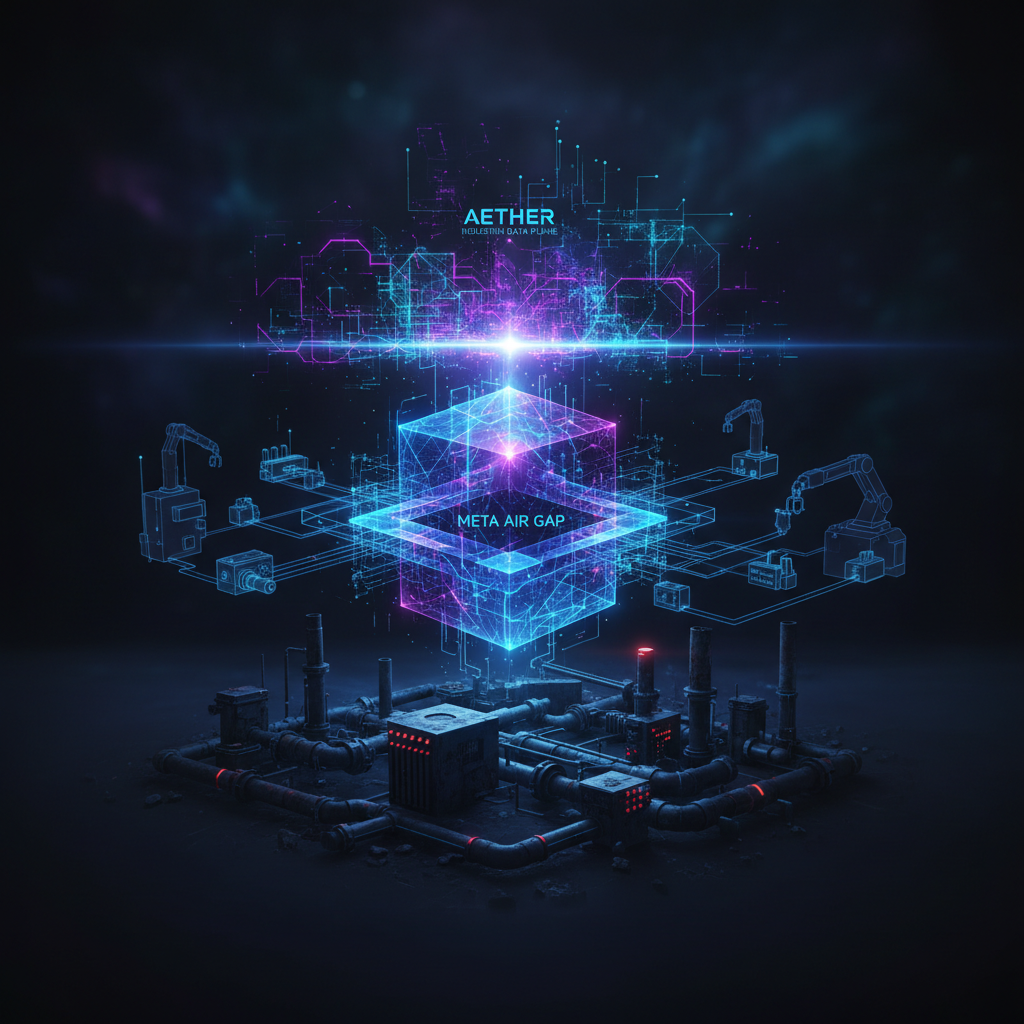
VeilNet solves this through the implementation of a Meta Air Gap. This is not a physical disconnection, but a cryptographic one. By leveraging an identity-authenticated mesh network, VeilNet ensures that industrial assets are completely invisible to the public internet. There are no open ports to scan and no routable IP addresses for an attacker to target. The network only exists for authorized users and devices, and even then, only at the moment of a verified connection.
This architecture ensures that even if an attacker gains access to a corporate IT network, they find no bridge into the OT environment. The Meta Air Gap effectively contains the threat at the point of origin, preventing the lateral movement that characterizes modern industrial breaches.
Conflux and the Foundation of Post Quantum Networking
At the heart of this secure architecture is VeilNet Conflux. While traditional Zero Trust Network Access (ZTNA) solutions rely on standard TLS encryption—which is increasingly vulnerable to the looming threat of quantum computing—Conflux is built from the ground up on post-quantum, quantum-resistant packet routing.
Conflux handles the foundational networking layer, providing a secure connector that bridges disparate sites and devices into a unified, encrypted mesh. Unlike traditional hub-and-spoke networks where traffic must pass through a central gateway (creating a single point of failure and a high-value target), Conflux enables direct, peer-to-peer connectivity. This mesh approach improves performance and eliminates the "bottleneck" effect, which is critical for time-sensitive industrial processes.
The security of Conflux is rooted in its identity-first approach. In a standard network, the network layer asks "Where are you going?" and the identity layer asks "Who are you?" Conflux merges these. Routing is itself dependent on identity. A packet cannot even be routed across the mesh unless it is signed and authenticated by a verified identity. This "identity-authenticated mesh" ensures that every single data packet is tied to a specific user or device, providing a level of granular control and auditability that is impossible with traditional IP-based routing.
For OT engineers, this means that legacy PLCs (Programmable Logic Controllers) or sensors that cannot defend themselves are shielded by a Conflux node. The node acts as the gatekeeper, handling the complex post-quantum cryptography and identity verification, while the legacy asset remains protected behind the cryptographic veil.
Aether and the Industrial Data Plane
Connectivity is only half of the equation. In an industrial environment, the value lies in the data—the sensor readings, the telemetry, and the control commands. However, the protocols that carry this data, such as OPC UA, are often complex and difficult to secure across a distributed network.
VeilNet Aether serves as the real-time engine that sits above the Conflux network layer. While Conflux secures the "pipes," Aether secures the "water" flowing through them. It provides a dedicated industrial data plane that handles the heavy lifting of protocol integration and data orchestration.
Aether is designed to natively support industrial standards like OPC UA, ensuring that data can be collected from the factory floor and delivered to the cloud or a remote monitoring station without ever being exposed to the public internet. But Aether goes beyond simple protocol translation. It incorporates support for the Model Context Protocol (MCP) and RESTful APIs, allowing industrial data to be integrated into modern AI-driven workflows and agentic systems.
This integration is vital for the modern "agentic workforce." As organizations deploy AI agents to monitor performance, predict maintenance needs, or optimize energy consumption, these non-human identities must be managed with the same rigor as human users. Aether provides the framework to discover, authenticate, and authorize these agentic identities, ensuring they have "least privilege" access to the specific data streams they need and nothing more.
Containment as a Mission Priority
The shift from detection to containment is not just a technical preference; it is a mission-critical requirement for national security and public safety. When dealing with life-safety systems, HVAC for hospitals, or energy control for the power grid, a "breach" is not an IT incident—it is a catastrophic event.
By separating the network layer (Conflux) from the data plane (Aether), VeilNet provides a dual-layer defense. Conflux ensures that the network is invisible and quantum-secure, while Aether ensures that the data is only accessible to authenticated entities through standardized, secure interfaces. This architecture allows organizations to close the gap between detection and containment. If an anomaly is detected, the identity-based mesh can instantly revoke access for that specific identity, severing the connection without impacting the rest of the network.
Furthermore, the "non-human" aspect of OT—the machines, sensors, and actuators—benefit most from this model. By treating every machine as a distinct identity within the mesh, VeilNet eliminates the concept of a "trusted internal network." In the VeilNet model, nothing is trusted by default, regardless of whether it is inside the physical walls of a plant or a remote sensor in the field.
Future Proofing the Industrial Core
As we look toward 2026 and beyond, the threats to industrial infrastructure will only grow more sophisticated. AI-driven phishing and automated exploit generation are shortening the window between vulnerability and compromise. At the same time, the progress in quantum computing is making today's encryption standards obsolete.
Relying on legacy cyber tools and traditional "perimeter" thinking is no longer a viable strategy. The path forward requires a new architectural blueprint—one that embraces the Meta Air Gap, mandates post-quantum security, and treats identity as the new perimeter.
VeilNet provides this blueprint. Through the combination of Conflux’s quantum-resistant mesh and Aether’s intelligent industrial data plane, organizations can finally solve the "Legacy Trap." They can connect their most sensitive assets to the digital world without ever truly "exposing" them. They can move beyond the fear of the next breach and toward a state of resilient, invisible, and absolute containment. The industrial world is changing; it is time for industrial security to lead the way.
Hardening AI Tool Infrastructure with Post Quantum Zero Trust
Secure sidecar-based MCP servers and AI agents with VeilNet's post-quantum zero-trust framework. Prevent tool poisoning and lateral movement today.
Hardening Model Context Protocol Servers against Lateral Movement and Quantum Threats
Secure Model Context Protocol (MCP) servers with post-quantum zero-trust networking. Prevent tool poisoning and lateral movement with VeilNet's Aether and Conflux.