Securing Industrial Operations with Quantum Resistant Zero Trust Microsegmentation
Securing Industrial Operations with Quantum Resistant Zero Trust Microsegmentation
The modern industrial landscape is undergoing a profound crisis of trust. For decades, operational technology (OT) relied on a simple physical defense: the air gap. The theory was straightforward—if critical infrastructure, manufacturing plants, and supervisory control systems were physically disconnected from corporate IT and the internet, they were secure. But in the era of industrial automation, remote diagnostics, and predictive analytics, the hard physical air gap has become an operational relic. Systems must talk to one another, telemetry must flow to analytical models, and maintenance teams require remote access.
As these systems converge, the vulnerabilities of legacy OT protocols become painfully apparent. Traditional industrial networks are inherently flat, designed for high availability and low latency rather than cryptography and access control. Once an adversary gains access to a single controller or localized network loop, they face virtually no resistance moving laterally. Legacy virtual private networks (VPNs) and firewalls only secure the perimeter, doing nothing to police traffic inside the perimeter. Industrial operators are realizing that traditional identity management and perimeter controls are no longer sufficient to guarantee operational resilience. True security in the modern OT environment requires deep network microsegmentation, continuous verification, and preparation for future cryptographic threats.
The Mirage of the Physical Air Gap
To protect critical infrastructure without halting modern business operations, organizations must move past the illusion of the physical air gap. Today's industrial environments are hyper-connected. Engineers connect laptops to programmable logic controllers (PLCs) for updates, third-party vendors monitor turbines remotely, and corporate databases pull real-time production metrics directly from the factory floor. Every single one of these touchpoints represents a potential bypass of the physical air gap.
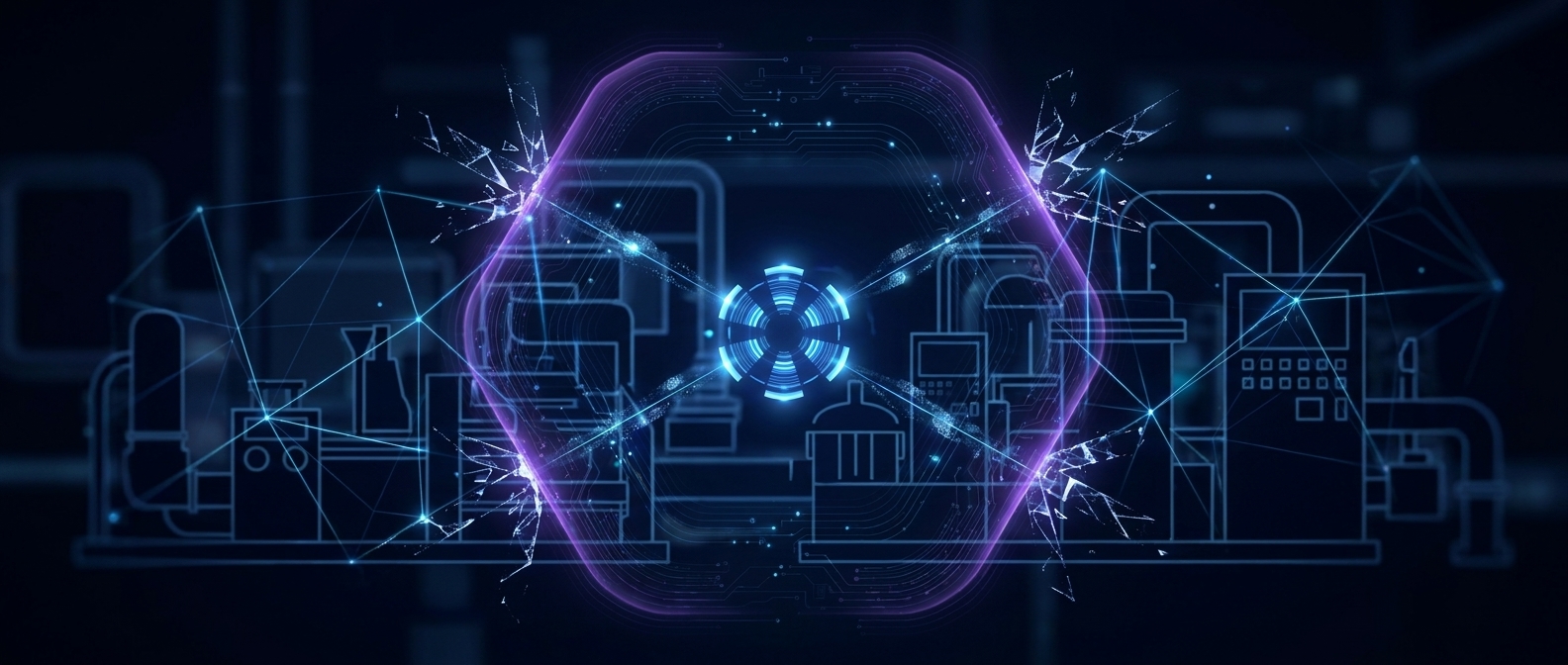
When a physical air gap is compromised, the consequences are immediate. Traditional OT protocols—such as Modbus, DNP3, and legacy implementations of OPC UA—lack cryptographic authentication, treating any command received over the network as legitimate. To secure these environments, organizations must implement what is known as a meta air gap: a software-defined, highly segmented network architecture that provides the isolation of a physical air gap without sacrificing the data flow required for modern industrial operations.
In this architecture, implicit trust is completely eliminated. Devices do not have IP visibility on a shared local network. Instead, every connection is treated as untrusted by default, requiring cryptographic proof of identity and context before a single packet is routed. This level of granular containment ensures that even if a local workstation or controller is compromised, the threat is completely isolated, preventing lateral movement across the rest of the operational facility.
Conflux and the Architecture of Post Quantum Mesh Networking
Achieving this rigorous level of network isolation requires a fundamental shift in how packets are routed. This is where Conflux, VeilNet’s post-quantum network connector, redefines the paradigm. Conflux builds an identity-authenticated mesh network directly over existing physical infrastructure, replacing vulnerable traditional routing protocols with cryptographically secured, peer-to-peer tunnels.
Unlike conventional networking, where IP addresses dictate routing and imply trust, Conflux decouples identity from physical network location. Every node on the Conflux mesh is assigned a unique, cryptographic identity. Packet routing is entirely dependent on continuous mutual authentication between these endpoints. If a device cannot cryptographically prove its identity, it is completely invisible to the rest of the network—rendering the protected assets totally dark to unauthorized scanners and attackers.
Crucially, Conflux is designed with the impending threat of quantum computing in mind. Standard cryptographic algorithms used in legacy zero-trust architectures, such as RSA and standard Elliptic Curve cryptography, are highly vulnerable to future quantum decryption capabilities. If an adversary captures encrypted OT traffic today, they can store it and decrypt it once cryptographically relevant quantum computers become available. Conflux mitigates this risk by integrating state-of-the-art post-quantum cryptographic (PQC) algorithms directly into its packet routing and identity verification mechanisms. This ensures that the meta air gap remains impenetrable not only against contemporary threats but also against future quantum-assisted adversaries.
Aether and the Real Time Industrial Data Plane
While Conflux secures the network connector layer, the industrial environment requires a data plane capable of understanding and sanitizing complex operational telemetry. This is the domain of Aether, VeilNet’s real-time engine. Operating seamlessly above the Conflux network layer, Aether provides the translation, mediation, and policy enforcement necessary for secure industrial data exchange.
Industrial plants run on a diverse array of protocols, with OPC UA (Open Platform Communications Unified Architecture) serving as a primary standard for industrial interoperability. Aether acts as a secure, real-time gateway that ingests OPC UA telemetry, translates it, and governs it according to strict access policies. Instead of exposing raw OPC UA ports to the wider network, Aether abstracts these connections, ensuring that only authenticated, authorized data queries are processed.
Furthermore, Aether bridges the gap between OT and modern IT systems by integrating seamlessly with RESTful APIs and the Model Context Protocol (MCP). As enterprises deploy advanced analytical engines, machine learning models, and agentic AI platforms to optimize production, they require real-time access to factory floor metrics. Aether securely exposes this data via structured, authenticated API endpoints. By utilizing Aether, organizations can feed critical telemetry to external monitoring dashboards and automated control systems without ever exposing the underlying physical control loops or PLCs to direct network access. This clean separation of the data plane from the network control plane ensures that operations remain resilient, predictable, and secure.
Stopping Lateral Movement through Continuous Verification
The true measure of a zero-trust architecture is its ability to contain an active breach. If an adversary manages to compromise a low-security device, such as an IP camera or an office printer on an adjacent network, a properly segmented architecture must prevent them from jumping to the safety-instrumented systems of a chemical plant or power grid.
By combining the network-level microsegmentation of Conflux with the real-time data inspection of Aether, VeilNet creates an environment where lateral movement is mathematically and architecturally impossible. Every single connection session is ephemeral and bounded by context-aware security policies. When an OT engineer or an automated application requests access to a controller, the system evaluates not just their identity credentials, but their cryptographic state, their location, and the precise command they are attempting to execute.
If any anomaly is detected, or if the session exceeds its highly restricted time window, the connection is instantly severed. There are no persistent network paths, no open listening ports, and no implicitly trusted zones. The network dynamically adapts, maintaining the absolute isolation of critical assets while facilitating the precise, authorized flow of operational data.
Building Lasting Operational Resilience
Transitioning to a post-quantum zero-trust framework is no longer a forward-looking luxury; it is an immediate operational necessity. As regulatory frameworks tighten and the frequency of targeted attacks on critical infrastructure rises, industrial operators must move past outdated, perimeter-based security models.
By deploying Conflux to establish an identity-authenticated, quantum-resistant meta air gap, and utilizing Aether to govern the real-time OPC UA and API data plane, organizations can achieve true operational resilience. This dual-product architecture allows CISOs and OT engineers to fearlessly embrace digital transformation, secure in the knowledge that their physical assets are protected by the strongest cryptographic defenses available today—and prepared for the challenges of tomorrow.
Securing Industrial Networks at the Traffic Layer Against Lateral Threat Movement
Traditional zero trust architectures fail at the traffic layer. Learn how VeilNet Conflux and Aether eliminate lateral movement and secure industrial data.
Securing Critical Infrastructure When the Primary Network Goes Dark
How do you maintain Zero Trust security when wide-area networks fail? Discover how VeilNet Conflux and Aether keep critical infrastructure operating securely.