Securing Industrial Control Systems Against Quantum Era Threats
Securing Industrial Control Systems Against Quantum Era Threats
The traditional concept of a "secure perimeter" in operational technology (OT) is no longer a viable defense strategy. For decades, infrastructure architects relied on air gaps, firewalls, and virtual private networks (VPNs) to shield critical systems—HVAC controllers, energy grids, and manufacturing lines—from the public internet. However, a new class of sophisticated adversary has emerged, one that does not simply "break in" but rather "pre-positions" itself within these networks. By utilizing living-off-the-land (LOTL) techniques, these threat actors blend into normal operations using legitimate administrative tools, making detection nearly impossible for legacy security stacks.
In this environment, the "assume breach" mindset is the only logical starting point. When nation-state actors are already inside the wire, the goal of security shifts from keeping people out to preventing lateral movement and ensuring that even a compromised endpoint cannot compromise the mission. This is the fundamental challenge facing modern CISOs and OT engineers: how to build a network that is inherently resilient to internal threats while simultaneously preparing for the looming arrival of cryptographically relevant quantum computers.
The Fallacy of the Perimeter Defense
The primary weakness of traditional OT security is its reliance on IP-based trust. In a standard network, once a user or device successfully authenticates through a VPN or passes through a firewall, they are often granted broad access to the internal segment. This "crunchy shell, soft middle" architecture is exactly what modern adversaries exploit. Once an attacker gains a foothold—often through stolen credentials or a zero-day exploit in a gateway—they move laterally, scanning the network for sensitive industrial controllers or data repositories.
Furthermore, the very protocols that drive industrial automation, such as OPC UA, were often designed for connectivity rather than hardened security. While modern iterations of these protocols have improved, the underlying network remains the bottleneck. If the network allows a packet to reach a device before identity is verified, the attack surface remains exposed.
The rise of the "Harvest Now, Decrypt Later" (HNDL) strategy adds another layer of urgency. Adversaries are currently intercepting and storing encrypted traffic from critical infrastructure, waiting for the day when quantum processors can break RSA and ECC encryption. For OT assets with lifecycles spanning twenty to thirty years, the threat of quantum decryption is not a future problem—it is a present-day risk to long-term data integrity and control.
Conflux and the Architecture of the Meta Air Gap
To address these vulnerabilities, VeilNet introduces Conflux, a secure post-quantum network connector designed to replace the fragile perimeter with an identity-authenticated mesh network. Conflux operates on a principle of total isolation, creating what we define as the "meta air gap."
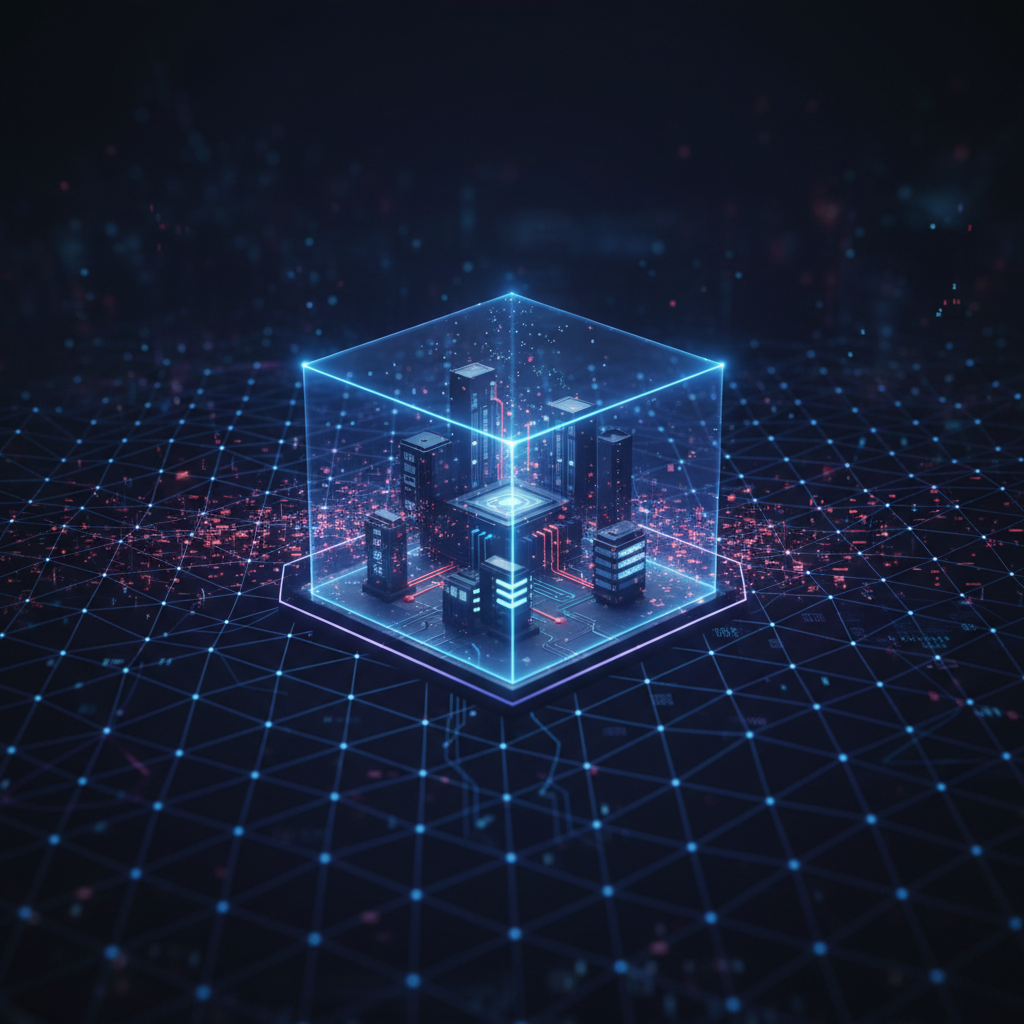
Unlike a physical air gap, which is often bypassed by technicians for convenience or maintenance, the meta air gap is a logical construct enforced at the packet level. In a Conflux-powered network, no device has an IP address reachable from the public internet. Connectivity is established through identity-authenticated tunnels that are invisible to unauthorized observers. If a device cannot present a cryptographically verified identity, it simply does not exist on the network layer. This effectively eliminates the "pre-scanning" phase of a cyberattack, as there are no open ports or broadcasted addresses to discover.
The routing mechanism within Conflux is inherently quantum-resistant. By implementing post-quantum cryptography (PQC) for all mesh networking functions, Conflux ensures that traffic intercepted today remains secure against the quantum computers of tomorrow. This is a critical requirement for infrastructure architects who must guarantee the security of systems that will remain in service for decades. Conflux doesn't just encrypt the data; it secures the routing itself, ensuring that the very structure of the network is resilient to the "Harvest Now, Decrypt Later" threat.
Aether and the Modern Industrial Data Plane
While Conflux handles the underlying connectivity and network security, the industrial logic requires a different level of intelligence. This is where Aether, VeilNet’s real-time engine, provides the industrial data plane above the Conflux layer. Aether is designed specifically to handle the complexities of industrial data movement, providing seamless integrations for OPC UA, RESTful APIs, and the Model Context Protocol (MCP).
In a traditional setup, exposing an OPC UA server to a remote application requires complex firewall rules and often introduces significant latency. Aether streamlines this by acting as the intelligent bridge between the OT environment and the broader enterprise or cloud infrastructure. Because Aether sits on top of the Conflux mesh, all data moving through it is already protected by identity-authenticated tunnels and post-quantum encryption.
Aether allows OT engineers to define granular access policies at the protocol level. Instead of granting a remote user access to an entire network segment, Aether can restrict them to specific OPC UA nodes or RESTful endpoints. This micro-segmentation of the data plane ensures that even if a user’s credentials are compromised, their access is limited to the bare minimum required for their role.
The integration of the Model Context Protocol (MCP) within Aether further future-proofs the industrial stack. As AI-driven monitoring and automated diagnostics become standard in OT, Aether provides the secure, low-latency conduit required for these models to interact with real-world sensor data without exposing the underlying controllers to the public internet.
Eliminating Lateral Movement
The combination of Conflux and Aether solves the most persistent problem in OT security: lateral movement. When an adversary enters a traditional network, they can see other devices. In a VeilNet environment, every connection is a peer-to-peer relationship defined by identity. There is no "internal network" to traverse.
If a technician’s workstation is compromised, the attacker finds themselves in a vacuum. They cannot scan for other devices because there are no shared network segments. They cannot spoof IP addresses because routing is tied to identity certificates that are protected by quantum-resistant algorithms. To move from the workstation to a PLC (Programmable Logic Controller), the attacker would need to compromise a entirely separate, identity-authenticated path that is strictly governed by the Aether data plane.
This architecture directly counters the living-off-the-land techniques identified by global security agencies. Adversaries cannot use legitimate administrative tools to move through the network if the network itself refuses to route their packets. By decoupling connectivity from IP addresses and anchoring it in cryptographic identity, VeilNet renders the adversary’s lateral movement toolkit obsolete.
The Mandate for Post-Quantum Resilience
As critical infrastructure becomes increasingly interconnected, the window of opportunity for legacy security models is closing. The move toward Zero Trust in OT is no longer a theoretical exercise but a practical necessity for maintaining operational continuity. CISOs must look beyond the immediate threats of ransomware and malware to the structural vulnerabilities of their network architecture.
VeilNet’s Conflux and Aether provide the foundational components for this transition. By establishing a meta air gap through identity-authenticated mesh networking and providing a secure, protocol-aware data plane for industrial integrations, VeilNet allows organizations to embrace digital transformation without sacrificing security.
The goal is not just to survive today’s attacks but to build a network that is secure by design for the next thirty years. Whether it is protecting against the pre-positioning of nation-state actors or securing long-lived assets against the quantum threat, the path forward requires a departure from the perimeter-based thinking of the past. With the deployment of quantum-resistant packet routing and granular industrial data controls, the meta air gap becomes the new standard for resilience in the modern age.
Securing the Industrial Autonomous Frontier with Post Quantum Zero Trust
Secure industrial OT systems against 1.3 billion AI agents with VeilNet. Learn how Conflux and Aether provide post-quantum zero-trust connectivity and MCP support.
Securing the Industrial Edge Beyond the Illusion of Network Perimeters
Learn how VeilNet Conflux and Aether eliminate vulnerable VLAN-based perimeter security at the industrial edge with post-quantum zero-trust networking.