Overcoming the Critical Zero Trust Data Movement Bottleneck
The Hidden Crisis in Modern Network Architecture
In the current industrial and enterprise landscape, a dangerous paradox has emerged. Organizations are being told to move faster, share more data, and integrate disparate systems across IT and OT environments. Yet, the security frameworks designed to protect these assets are creating a massive bottleneck. When the friction of moving data securely becomes too high, the result is a regression into manual transfers, shadow IT, and security exceptions that render the original Zero Trust strategy meaningless.
The problem isn't the concept of Zero Trust itself, but the legacy infrastructure we are trying to force it into. Traditional networking relies on a perimeter-based mindset—even when wrapped in a ZTNA (Zero Trust Network Access) label. This approach often fails to address the underlying reality of data movement in a world where quantum computing threats and sophisticated AI-driven attacks are no longer theoretical. To solve the data movement bottleneck, we must move beyond bolting security onto the network and instead build the network as an inherent security layer.
The Failure of Traditional Connectivity
Most organizations today suffer from a "visibility-connectivity" gap. To get data from an industrial sensor (OPC UA) to a cloud-based analytics engine, they typically rely on complex VPN tunnels, jumped jump-hosts, or physical "sneaker-nets" for high-security environments. These methods are either too porous, allowing lateral movement once a tunnel is breached, or too rigid, preventing the real-time data flow necessary for modern operations.
VPNs, in particular, are a significant part of the problem. They provide a fat pipe into a network segment based on a perimeter check. Once the user or device is "in," they often have broad access to everything on that segment. This is the antithesis of Zero Trust. Furthermore, these tunnels are vulnerable to harvesting attacks today that will be decrypted tomorrow by quantum computers. This is where the bottleneck originates: the fear of breach leads to restrictive policies that stifle the very data sharing required for innovation.
Conflux and the Architecture of the Meta Air Gap
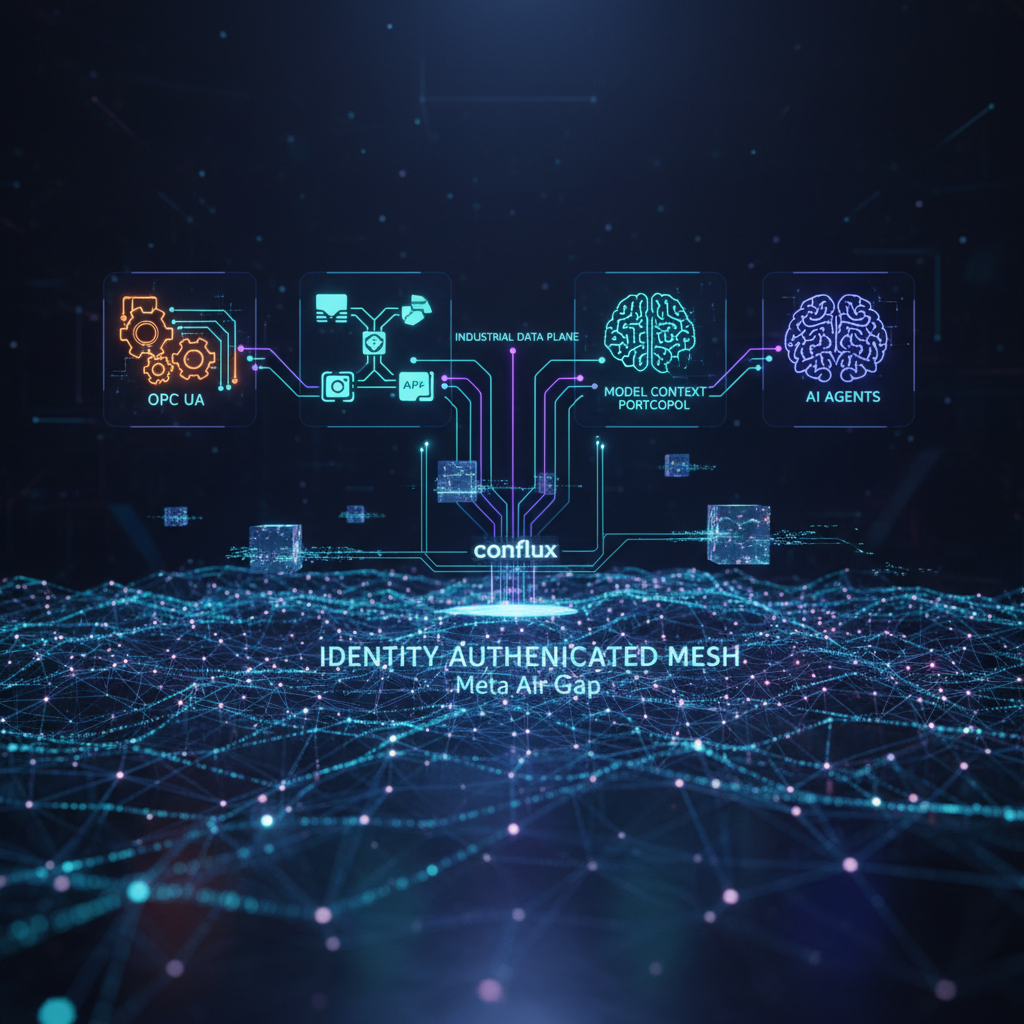
VeilNet approaches this problem through two distinct but integrated layers. The foundation is Conflux, our secure post-quantum network connector. Conflux transforms the way devices and networks communicate by establishing an identity-authenticated mesh.
Unlike traditional routing, Conflux operates on a "deny-by-default" principle at the packet level. It creates what we call a Meta Air Gap. Historically, an air gap meant physical isolation—no wires, no connection. In the modern era, that is impossible. Conflux provides the software-defined equivalent. It allows for the seamless movement of data while ensuring that no unauthorized entity even knows the connection exists. There are no open ports to scan and no broad network segments to traverse.
Key to this architecture is quantum-resistant packet routing. We recognize that the data being moved today—intellectual property, critical infrastructure telemetry, and sensitive financial records—must be protected against future decryption capabilities. Conflux integrates post-quantum cryptography into the mesh itself, ensuring that even if a packet is intercepted, it remains indecipherable to both current and future adversaries. This removes the "security tax" on data movement, allowing CISOs to authorize cross-network sharing with the confidence that the transport layer is fundamentally unbreakable.
Aether and the Industrial Data Plane
If Conflux is the secure tunnel through which the data travels, Aether is the engine that ensures the data is meaningful, reachable, and integrated. Aether acts as the real-time industrial data plane sitting above the Conflux network layer.
The data movement bottleneck is often a protocol problem. Industrial environments run on OPC UA; IT environments run on RESTful APIs; modern AI agents interact via the Model Context Protocol (MCP). Bridging these worlds usually requires a series of fragile gateways and middleware that add latency and create new attack surfaces.
Aether eliminates this complexity. It provides native integration for OPC UA, RESTful APIs, and MCP, allowing for a unified data fabric across the entire organization. When an OT engineer needs to expose a specific set of sensor data to an IT-based machine learning model, Aether handles the protocol translation and delivery over the secure Conflux mesh. This isn't just about moving bits; it's about moving verified, identity-authenticated data points.
By integrating MCP, Aether also future-proofs the network for the age of AI. It allows AI models and agents to securely query industrial state without direct, unfettered access to the underlying control systems. This granular control is what finally breaks the data movement bottleneck: security teams can say "yes" to data requests because they are authorizing a specific data flow rather than a broad network path.
Eliminating Manual Transfers and Security Exceptions
One of the most telling signs of a broken security strategy is the prevalence of manual data transfers. When engineers start carrying USB drives across the factory floor or using personal file-sharing services to bypass corporate firewalls, the network has failed. These "shadow" movements occur because the official path is too slow or too difficult to navigate.
The VeilNet platform is designed to make the secure path the easiest path. Because Conflux utilizes a peer-to-peer mesh architecture, there is no central hub or bottleneck. Data moves directly from source to destination, authenticated at every step. This removes the performance lag often associated with centralized security inspection points.
Furthermore, because Aether provides such granular control over the data plane, the need for "security exceptions" is virtually eliminated. In a traditional environment, a project might require a temporary opening in a firewall—an opening that is frequently forgotten and left as a permanent vulnerability. With VeilNet, access is tied to identity and specific data protocols. When the project is over, or the identity is revoked, the access disappears automatically. There are no "leftover" holes in the perimeter because there is no perimeter.
Scaling Zero Trust for Global Infrastructure
For global enterprises, the data movement bottleneck is magnified by geography and scale. Managing thousands of VPN tunnels across continents is a nightmare for infrastructure architects. Conflux simplifies this through its software-defined nature. Whether a node is in a Tier 3 data center, a remote wind farm, or a cloud instance, it joins the same identity-authenticated mesh.
This scalability is vital for the "Assume Breach" mentality of Zero Trust. If one node is compromised, the mesh architecture ensures the threat is contained. The compromised device has no "trusted" network to move laterally through. It only has the specific, identity-first connections that were explicitly granted. In the time it takes an attacker to realize they are in a dead-end, VeilNet’s monitoring tools have already identified the anomaly and severed the identity's credentials.
A New Standard for Cyber Resilience
The path forward for CISOs and OT engineers is clear: we must stop treating the network and security as separate entities. The data movement bottleneck is a symptom of a fragmented architecture.
By deploying Conflux and Aether, organizations can finally realize the full promise of Zero Trust. They can move data at the speed of business while maintaining a post-quantum security posture. They can bridge the gap between legacy industrial protocols and modern AI applications without compromising the integrity of critical systems.
VeilNet doesn't just secure the data; it enables the data. We provide the infrastructure that allows organizations to stop worrying about the "how" of secure connectivity and start focusing on the "what" of their data-driven initiatives. In an era where data is the most valuable asset, the ability to move it safely, quickly, and intelligently is the ultimate competitive advantage. It is time to retire the manual transfers, close the security exceptions, and embrace a network architecture that is secure by design, resistant by nature, and ready for the quantum future.
Overcoming the Zero Trust Data Bottleneck in Modern Industrial Networks
Solve the zero-trust data movement bottleneck in modern OT environments. Learn how VeilNet's Conflux and Aether enable secure, cross-network data flows.
How Post Quantum Mesh Networks Shield Legacy Operational Technology
Discover how combining VeilNet Conflux and Aether creates an invisible, quantum-resistant mesh network to secure legacy OT systems and legacy OPC UA protocols.